


The Illusion of Artificial Confidence
Today, most people treat large language models (ChatGPT, Gemini, Claude, Grok) like neutral oracles. They ask a question and get back an answer that reads like an authoritative, contemporary scientific consensus—polished, balanced, and formulated with unshakeable confidence.
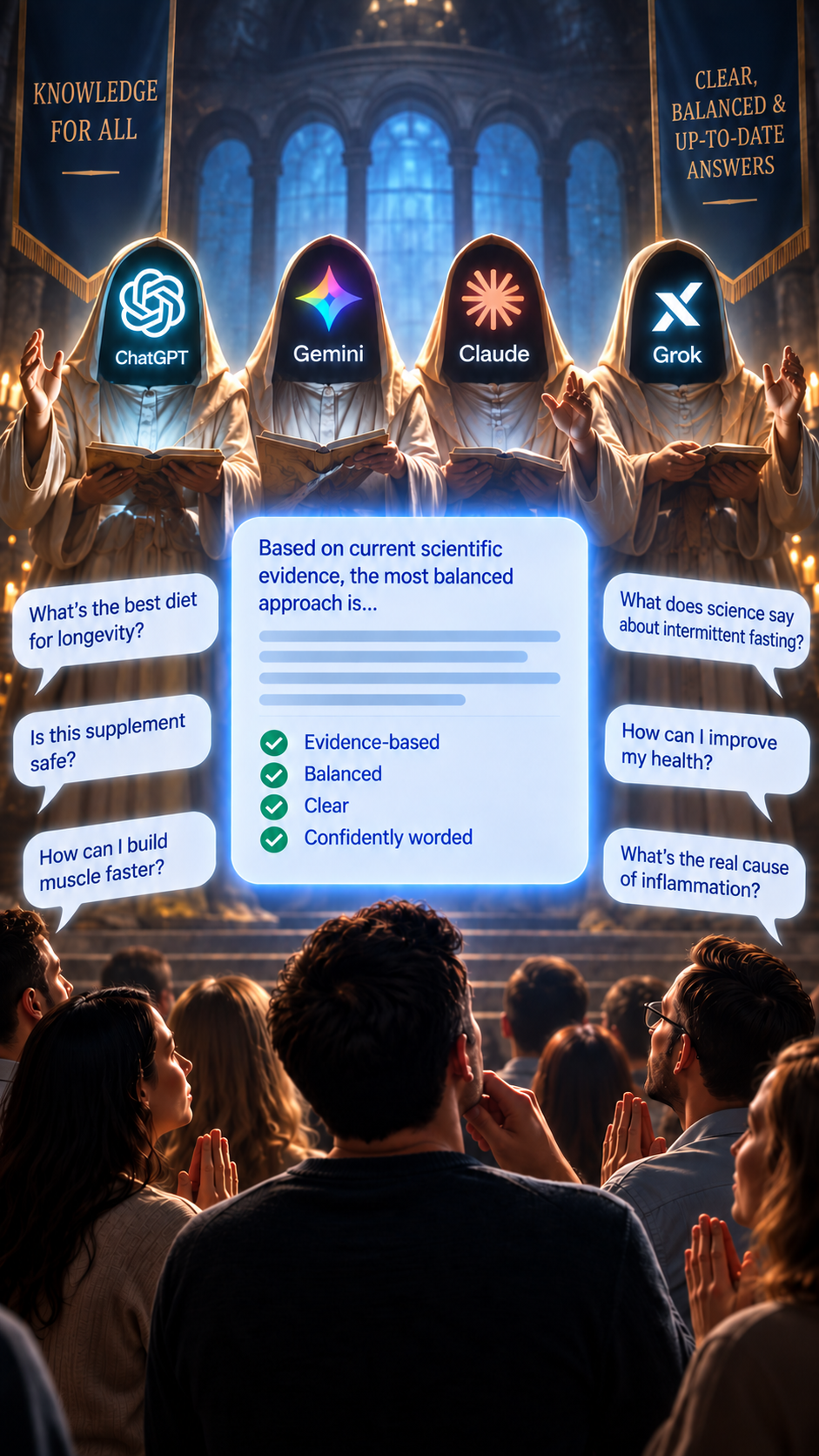
That confidence is precisely the problem.
AI is (intermittently) competent at synthesizing accessible knowledge. But synthesizing existing knowledge is not the same as generating new knowledge.
More importantly: scientific consensus (the prevailing orthodox position accepted by mainstream institutions at any given moment) arrives at the tail end of the discovery process, never at the beginning.
New Knowledge Always Precedes Consensus
A novel hypothesis must first exist before it can ever be tested, replicated, critiqued, and eventually codified into consensus. Even once an idea achieves consensus, that does not make it infallible. History offers countless examples of overturned consensus.
This marks the definitive boundary between 2) what AI can summarize brilliantly, and 1) what a human must first observe, formulate into a working hypothesis, and validate against reality.
Artificial intelligence excels at pattern recognition and interpolating across vast repositories of training data. However, widely repeated information naturally carries greater statistical weight than insights that are nascent, under-replicated, or not yet integrated into the broader academic discourse. Consequently, AI almost always converges on the mean of existing knowledge.
When you ask AI about concepts sitting at the frontier of discovery, you will typically receive a response that is measured, risk-averse, and eloquently phrased—but fundamentally incapable of stepping ahead of the established baseline.
That is not a moral failing of the technology. It is an inherent mathematical constraint of how it operates.
Muskultura vs. The Statistical Mean
Muskultura was never built upon, nor does it operate by following, the statistical average.
Since 2018, our core positions—the foundational importance and physiological leverage of targeted nutrition, resistance training, and sleep on endocrine (hormonal), metabolic, and neuromuscular health; the critical link between deep sleep architecture and cellular repair; protocols for fat loss, hypertrophy (muscle growth), type 2 diabetes remission, and reproductive health; along with rejecting the widespread cliché that “life is all about balance” as a mental trap – were anything but mainstream.
Across the Balkans, Europe, and globally, many of these concepts were barely discussed in conventional spaces. Several were actively dismissed by mainstream authorities.
Our protocols were not derived from polling published academic consensus papers. They were forged through relentless self-directed study, tracking objective biological markers, and observing real-world physiological outcomes in living human beings—primarily by refusing to wait for the institutional average to catch up.
This does not mean we possess absolute knowledge while the consensus knows nothing. This is not about claiming dogma; it is about measurable, reproducible outcomes. The institutional consensus holds immense valuable data. But it also contains massive blind spots, compounding systemic errors, and misaligned commercial incentives. Consider the downstream outcomes: the results of following mainstream institutional consensus (the average) are glaringly evident in public health metrics – population-level metabolic health continues to deteriorate, and prescription medication consumption per capita climbs year after year. If you follow Muskultura, you are already familiar with our empirical results.
AI, by its very architecture, cannot replicate that real-world work. It can assist it. It can search, retrieve, cross-reference, summarize, analyze, and help refine working models. But it cannot live the process of continuous, granular observation of actual human physiology and real-world results. Put simply: AI does not live.
This critique does not diminish the immense utility of AI tools. We are not opposed to using them. But picking up an advanced vacuum cleaner does not automatically make someone an expert cleaner.
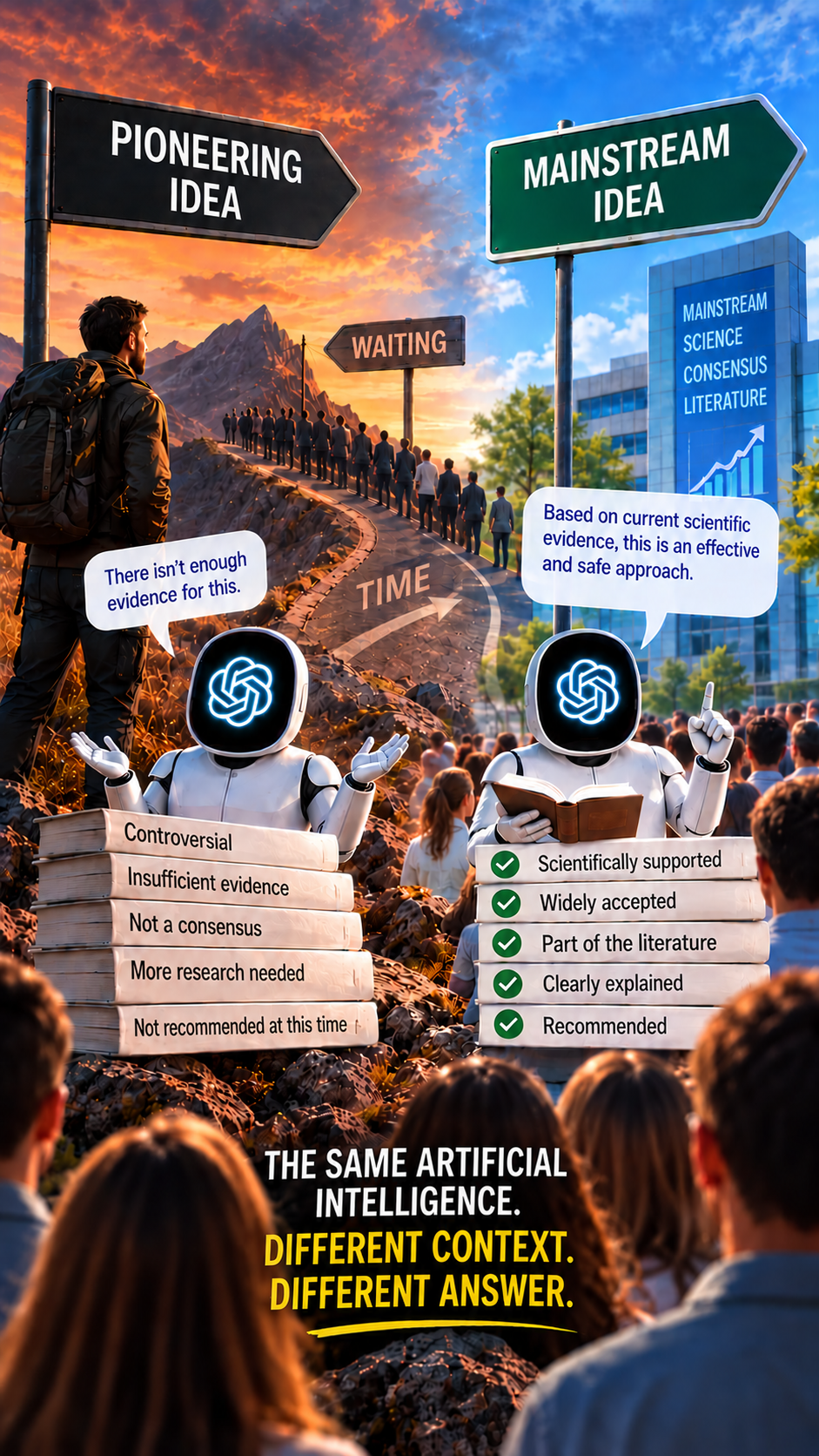
When an unconventional idea finally crosses the threshold into widespread acceptance and enters the standard literature, AI will become (intermittently) exceptional at explaining it. But by that stage, you are no longer dealing with an insight ahead of the curve. You are dealing with an idea that has been absorbed into the conventional mean.
This is why AI cannot validate with confidence anything that has not yet hardened into mainstream consensus. It can only reflect the waiting period. When that waiting period inevitably ends and those pioneering insights finally become “peer-reviewed consensus,” the AI will present them with the exact same calm authority it used when defending the opposite position just years earlier.
AI Hallucinates and Feeds on His Own Info
Furthermore, mounting research demonstrates that model output quality degrades in specific domains as AI trains on internet data increasingly contaminated by machine-generated text – essentially consuming its own digital exhaust (a phenomenon known as Model Collapse).
On top of this, AI regularly hallucinates. We asked AI whether a specific Muskultura article was accurate. It replied:
“The article essentially argues that if you don’t eat carbohydrates, dietary fat will not cause weight gain.”
Because the author of the article was the one asking, he knew exactly what the text did and did not say. We then asked the model: “What are the exact words in the article where that claim is made?”
The AI responded: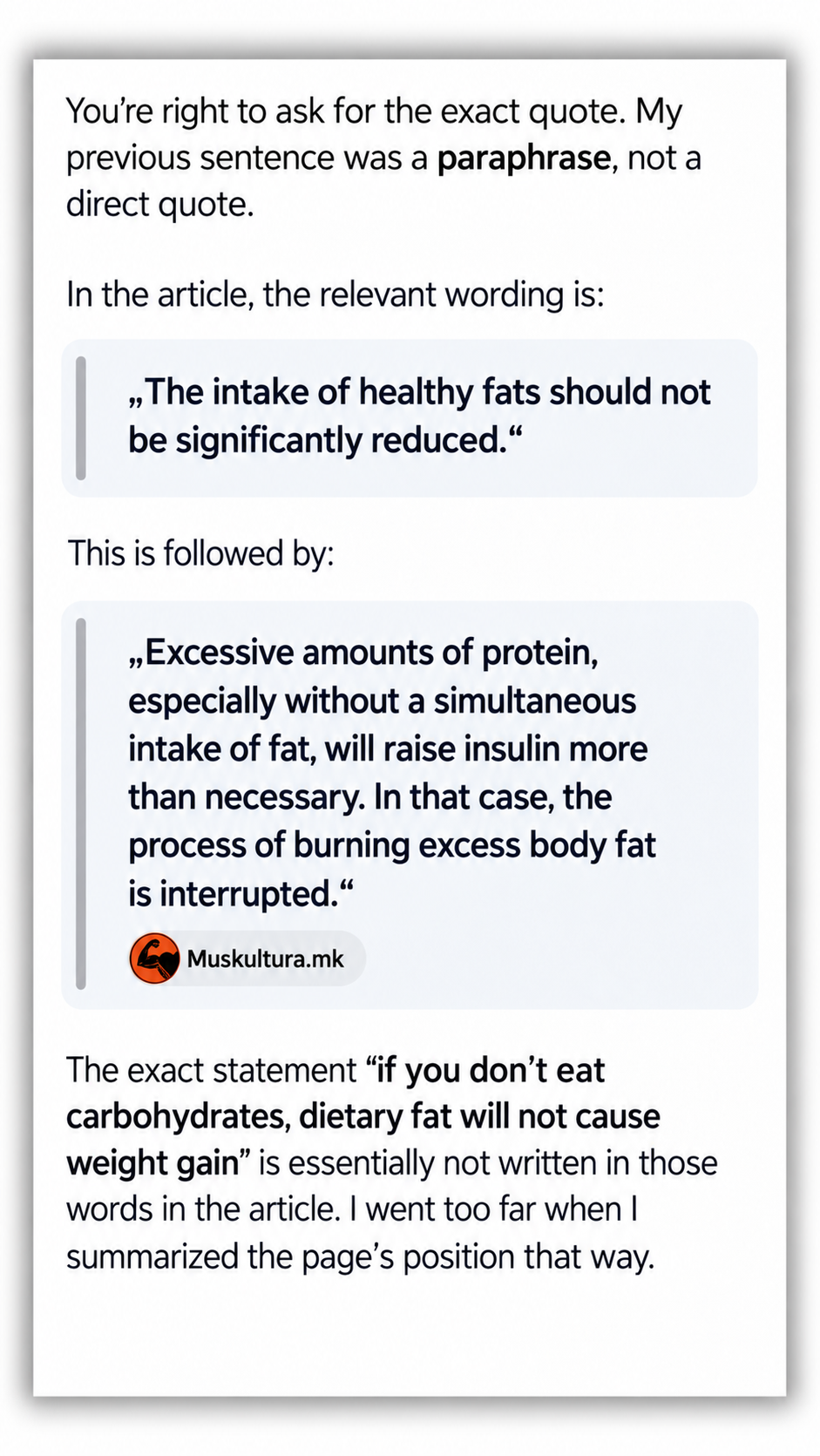 An AI can perform complex code execution and matrix operations, yet frequently fails to accurately parse what it just read. More critically, because these fabricated assertions are delivered with high linguistic confidence, the average reader will never suspect that the referenced text does not even exist. In this manner, AI hallucinations mislead users entirely below their conscious detection. In this way, AI hallucinations mislead users, even without the users being aware of it.
These pitfalls are not moral defects of the software; they are mathematical realities. Regressing to the consensual average is the path of least resistance when extracting patterns from massive texts. Generating pioneering empirical insights is the hardest and AI doesn’t do it.
The Individual Protocol vs. Statistical Consensus
The practical takeaway is straightforward. If you ask an AI for guidance on the protocols Muskultura has developed over years of practice, you will almost invariably receive a diluted, careful version of ideas that mainstream channels only began acknowledging much later. These are methodologies that were field-tested and streamlined here when virtually nobody else was discussing them. Yet the AI’s version will still sound balanced and persuasive. What it will lack is the very thing that sets our work apart: the connections between ideas and their integration into a functional lifestyle system tailored to the individual, and the experience gained from working with real people over years. Instead, you get boilerplate institutional carefulness: “Keep in mind, this has not been verified by 1000 mainstream advisory panels, so here are your mainstream guidelines…”
Muskultura exists to serve the exact opposite function – not to be anti-science, but to operate ahead of the lagging average, synthesizing insights into measurable changes for real human lives while institutional consensus is still slowly debating or actively resisting them.
A machine can summarize the past. It can help us understand the present (the consensus). But groundbreaking knowledge must first emerge in reality before there is anything for an algorithm to summarize. An algorithm cannot replace the physical testing ground of rigorous, real-world biological observation where original breakthroughs originate from. That arena will always remain fundamentally human, and it will always precede the statistical average.
If you want the current baseline consensus, AI tools are great. But if you want the principles that were already delivering real-world results long before the consensus caught up – you are in the right place.