


Cardiovascular disease has statistically been the leading cause of death worldwide for nearly a century.
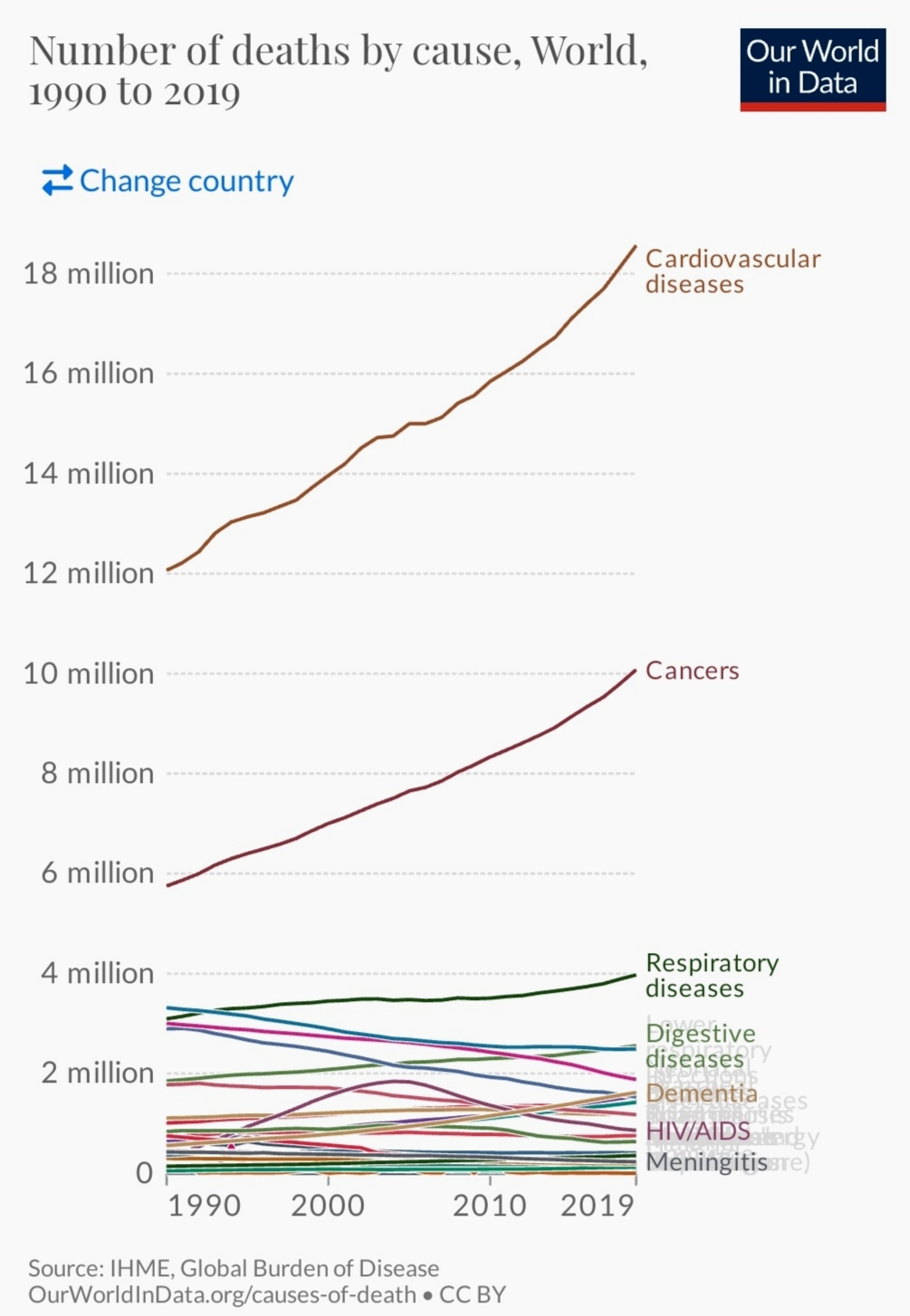
Causes and number of deaths worldwide from 1990 to 2019
It is widely accepted that the primary lifestyle risk factors for heart disease are:
- Diet
- Physical inactivity
- Smoking
- Alcohol, etc.
From a medical perspective, the primary factors are:
- High blood pressure
- Arteriosclerosis (hardening of the arteries)
- Diabetes
- Obesity (excess body weight)
You will notice that in the vast majority of medical guidelines and consensus statements, the frontline advice for prevention and management is dietary changes and starting physical activity. That is sound advice on paper. But as long as the incidence of these diseases continues to climb, something fundamental must be flawed with the conventional definition of diet. If you examine the assumptions underpinning that model, it becomes much clearer why the situation is the way it is.
The Body’s “Primary” Energy Source
Conventional wisdom says that carbohydrates (glucose) are the body’s primary energy source. This means the default food. That is what we have been taught for decades.
It is an established physiological fact that when fats and sugars are ingested simultaneously, the body prioritizes burning sugar for fuel.
Because of this, mainstream nutrition claims the body prefers sugar. Consequently, ketones (byproducts of lipid metabolism used as cellular fuel) are labeled an “alternative” substrate, while glucose is crowned the “primary” and “preferred” fuel.
This premise fills modern medical textbooks, biology curricula, bodybuilding programs, and athletic conditioning protocols: the belief that glucose is the indispensable foundation of human metabolism, and therefore you must constantly consume carbohydrates to sustain energy, mental acuity, and muscle growth.
These flawed paradigms carry an immense human cost.
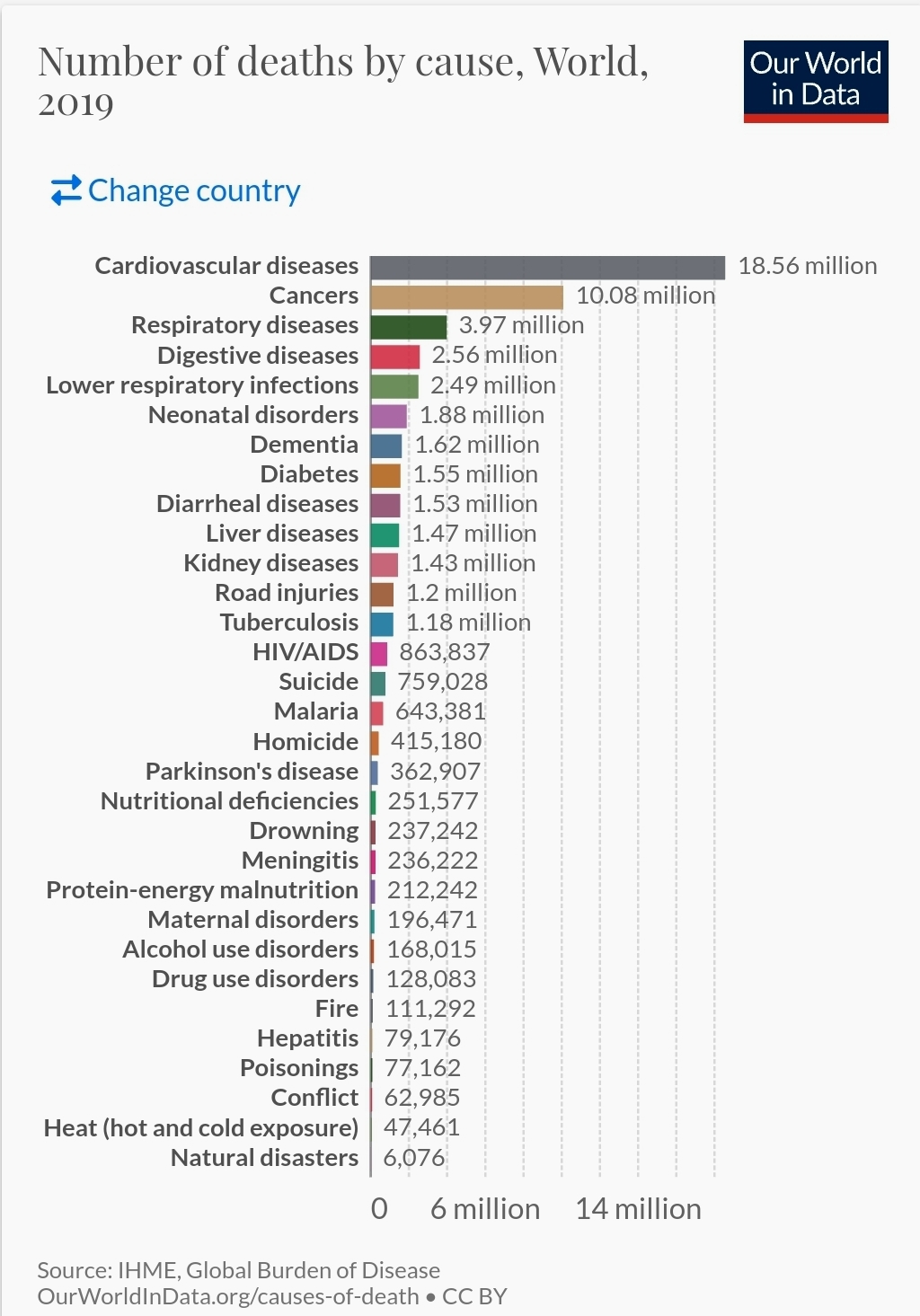
To put that cost in perspective: cardiovascular disease alone claims roughly 18 million lives worldwide each year. In a SINGLE year. That accounts for approximately 30% of all global deaths—surpassing the casualties of any single armed conflict.
Global deaths by cause, 2019
When people reflect on World War II, they immediately recall the catastrophic loss of life, estimated at 70 to 80 million over a span of six years.
Going by global health metrics, every single year matches the casualty toll of World War II.
Another critical issue is the widespread prevalence of chronically suppressed growth hormone (HGH), chronically low testosterone, and pathologically high levels of cortisol and insulin, along with all their downstream pathologies, operating at pandemic levels across modern society.
Why Sugar Is Not the Body’s Primary, Preferred Fuel
A healthy human bloodstream contains roughly 4 to 5 grams of dissolved glucose at any given moment—about one teaspoon. The body maintains this narrow physiological range through strict homeostatic mechanisms (self-regulating biological feedback loops). If levels climb, it actively clears the excess; if levels drop, it taps glycogen reserves or synthesizes glucose from fatty acids and amino acids via gluconeogenesis (the metabolic pathway that creates glucose from non-carbohydrate sources). The body is entirely capable of manufacturing all the glucose it requires. Beyond this tight physiological window, circulating blood sugar becomes functionally toxic to tissues and vascular endothelium (the delicate cellular lining of blood vessels).

Let’s examine this “glucose superiority” model and see why physiological reality indicates the EXACT OPPOSITE.
The body does not burn carbs or sugar first out of biological preference; it clears glucose first out of survival necessity. When circulating levels exceed baseline, disposal becomes an urgent physiological priority. Conflating emergency clearance with “preference” is the foundational error upon which decades of flawed dietary advice have been built.
Remember: in dietary metabolism, “carbohydrates” and “sugar” describe the same physiological endpoint. Whether complex or simple, fast-digesting or slow, carbohydrates are broken down and enter the bloodstream as monosaccharides (simple single-molecule sugars).
Consider what occurs when the body fails to clear excess serum glucose and concentrations remain pathologically elevated: systemic glycation, organ failure, diabetic ketoacidosis, and death. That is why the body urgently clears sugar from circulation.

The Flawed Logic of Conventional Nutrition Guidelines
Imagine you are having dinner with your family when a pipe bursts and floods the room. You immediately jump up to shut off the main valve and stop the water. Under the reductive logic of conventional nutrition, an observer would conclude: “You clearly prefer water damage over spending time with your family.”
Or imagine your camp is under constant threat from a bear, forcing you to grab a spear and defend your perimeter daily—so frequently that you barely have time to speak with your wife and children. Does that mean you prefer the bear to your family? Standard nutrition dogma would say: “Yes, you clearly chose the bear.”
In reality, you confront the threat so your family doesn’t get mauled.
The body acts with the same biological urgency toward excess blood sugar. Uncontrolled hyperglycemia damages nerve endings, microvasculature, and cellular structures from the inside out, even while packing on visceral adiposity (deep internal abdominal fat).
Labeling ketones an “alternative substrate” while institutional dietary guidelines push high-carbohydrate intake at every meal is a fundamentally rigged game. The dietary landscape has been systematically misaligned for over 50 years, and the population’s metabolic health data shows the outcome.
Asserting that human physiology “prefers” glucose and that ketosis is merely an emergency backup reflects a basic misunderstanding of human survival energetics by the very institutions tasked with studying them.
From these entrenched orthodoxies comes the myth that ketosis is abnormal or hazardous. Yet biochemical reality demonstrates the exact opposite.
The primary criterion used to label sugar a “preferred fuel” is simple: whenever it is present, the body rushes to burn or store it immediately.
Consider the biological hierarchy of substrates:
The body metabolizes three primary external fuels:
- Alcohol (ethanol)
- Sugar (glucose)
- Fat (fatty acids and ketones)

Whenever ethanol is present in the bloodstream, hepatic metabolism (liver processing) grants it absolute metabolic priority over both glucose and fatty acids. Alcohol yields roughly 7 calories per gram. Because ethanol is an acute toxin with no storage mechanism in tissue, the liver drops other metabolic processes to clear and oxidize it immediately. This metabolic triage completely halts lipid oxidation (fat burning) and suppresses glucose clearance. Since the body is occupied clearing alcohol, co-ingested carbohydrates and dietary fats are shunted straight into adipose storage (body fat). Any surplus acetate derived from ethanol metabolism is likewise converted into fatty acids via de novo lipogenesis (the synthesis of new fatty acids from non-fat precursors).
Yet the public has been taught to fear dietary fat above all else. In reality, atherogenic plaque (fatty deposits that calcify and narrow arteries) does not originate from clean dietary fats.
The Biological Realities:
- Humanity evolved, adapted, and survived in nutritional ketosis (fat and ketone oxidation).
- Human beings are born in ketosis.
Regarding the innate biology of ketosis: humans enter the world relying on ketone bodies. Neonatal physiology is inherently ketogenic during late gestation and immediately postpartum. Newborns carry substantial subcutaneous adipose stores specifically to supply fatty acids for ketone production, ensuring a steady energy supply for early brain development.

How children are subsequently stripped of this metabolic flexibility—indoctrinated by standard high-sugar feeding patterns based on flawed dietary dogmas—is reflected in the skyrocketing epidemiological data for type 2 diabetes, heart disease, subfertility, erectile dysfunction, retinopathy, low testosterone, metabolic obesity, stroke, and oncological conditions (cancers).
Targeted nutrition and structured resistance training are fundamental, non-negotiable tools for lifelong physiological health.
When you stop overloading your system with chronic glycemic spikes, your metabolism shifts into physiological ketosis, accessing stable, long-lasting energy reserves without the crashes caused by sugar dependence.
Clearer cognition, restored hormonal signaling, improved sexual function, sustained endurance, and metabolic vitality are far better outcomes than running on the metabolic hamster wheel—managing prescriptions, waiting in clinic queues, and trying to salvage declining health after the damage is done.
This is the foundation of modern physical culture: a deliberate, evidence-based approach to building a resilient, high-performing body.